What is Inflation?
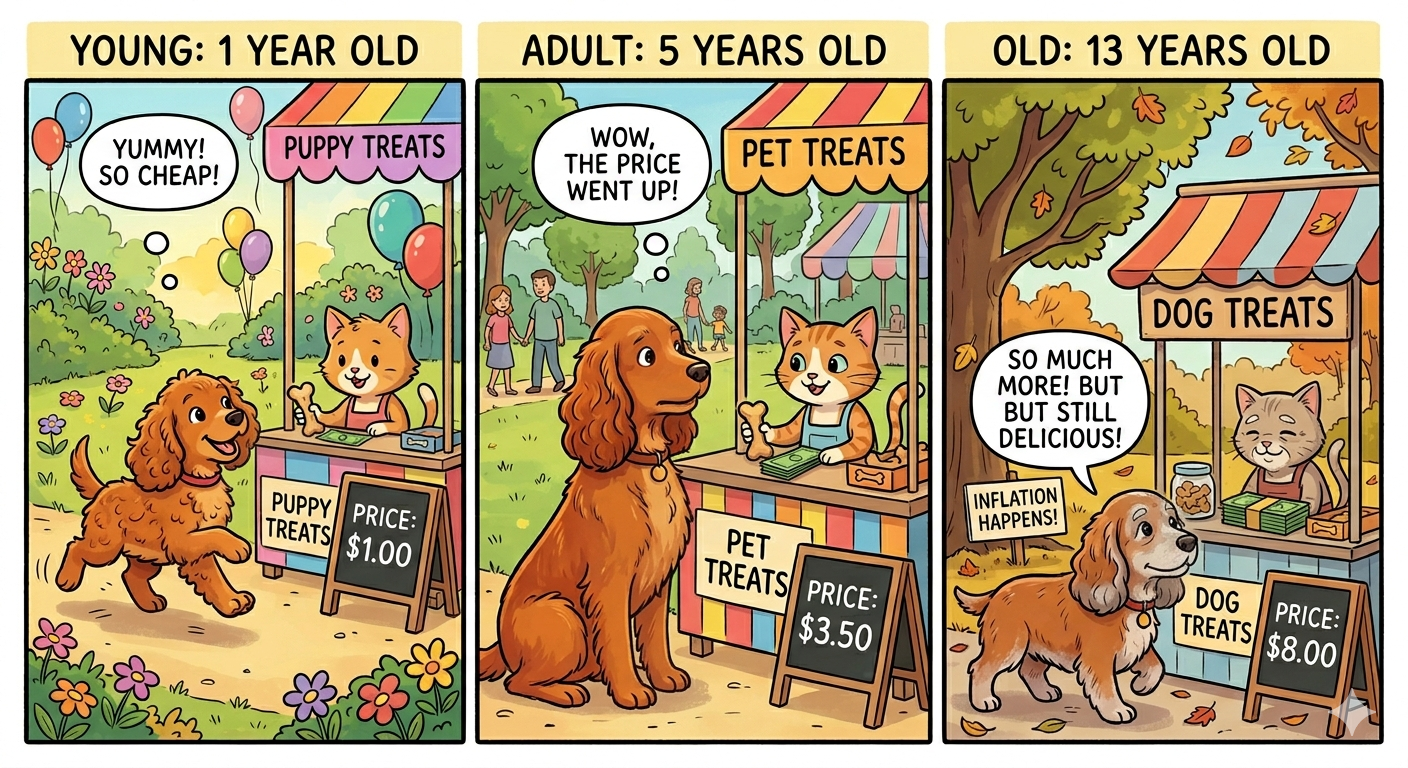
Inflation is the gradual increase in prices over time, which reduces what your money can buy. In the image, the same dog sees treats go from $1.00 to $3.50 to $8.00 as it ages—not because the treats got better, but because prices rose. That’s inflation in action: over the years, each dollar buys less than it used to.
How to Measure
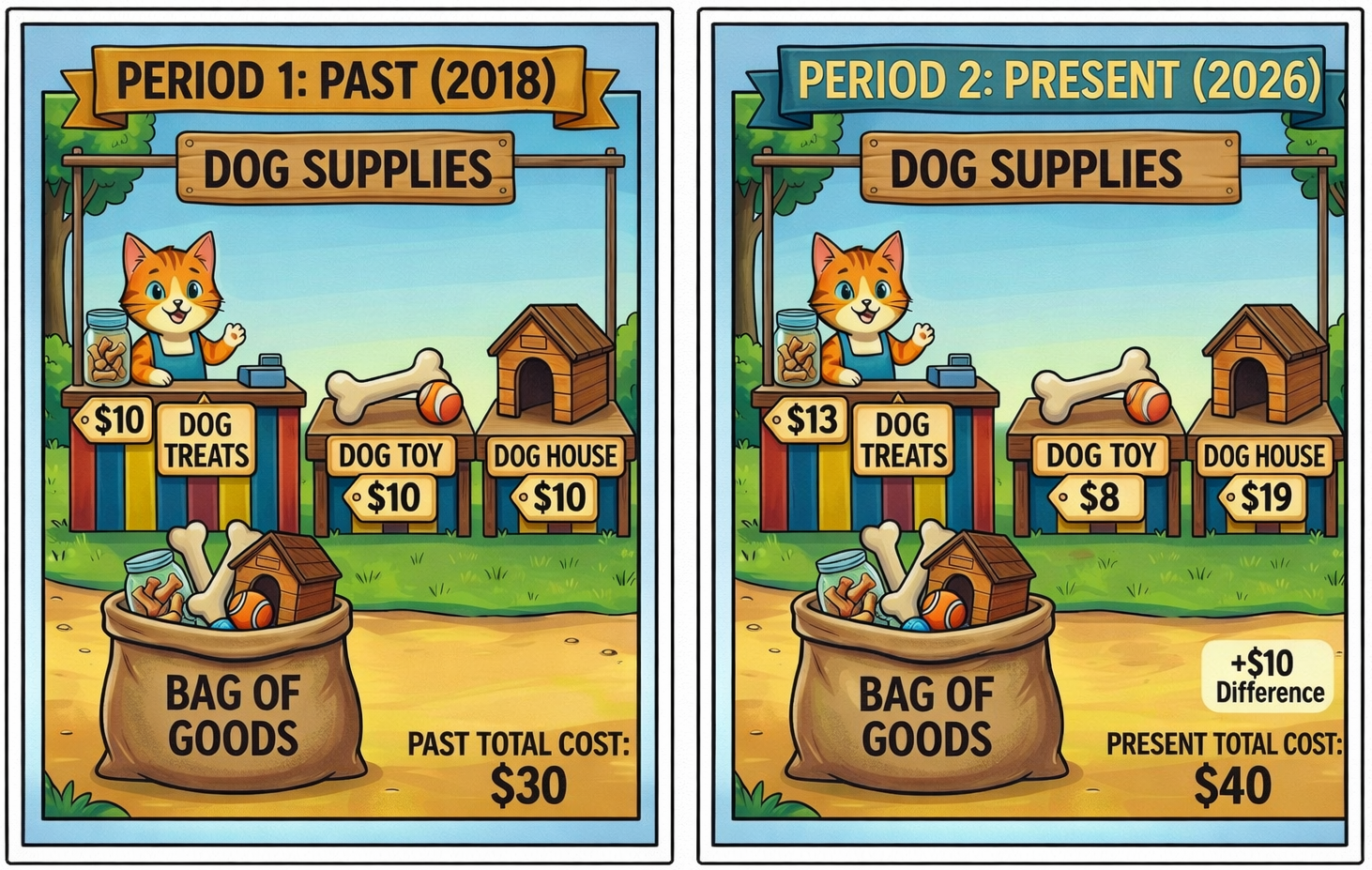
Not all prices rise at the same speed. Some items go up a lot (like the dog house), others less, and some might even get cheaper (as the dog toys). This is how real-world inflation works: it’s uneven across different goods and services.
To measure overall inflation, economists create a “basket” of common items—food, housing, transport, etc.—and track how the total cost of that basket changes over time. In the example, the same bundle of goods rises from $30 to $40, giving a simple estimate of inflation.
Different countries build and track these baskets in their own ways. In the United States, the main measure is the Consumer Price Index (CPI), which reflects typical urban consumer spending. In Brazil, the most widely used index is the IPCA, which guides monetary policy, while the IGP-M is also popular, especially for adjusting rents and contracts.
Even though each index uses a slightly different basket and methodology, they all aim to answer the same question: How much more (or less) does it cost to maintain a similar standard of living over time?
Why Your Money Loses Value
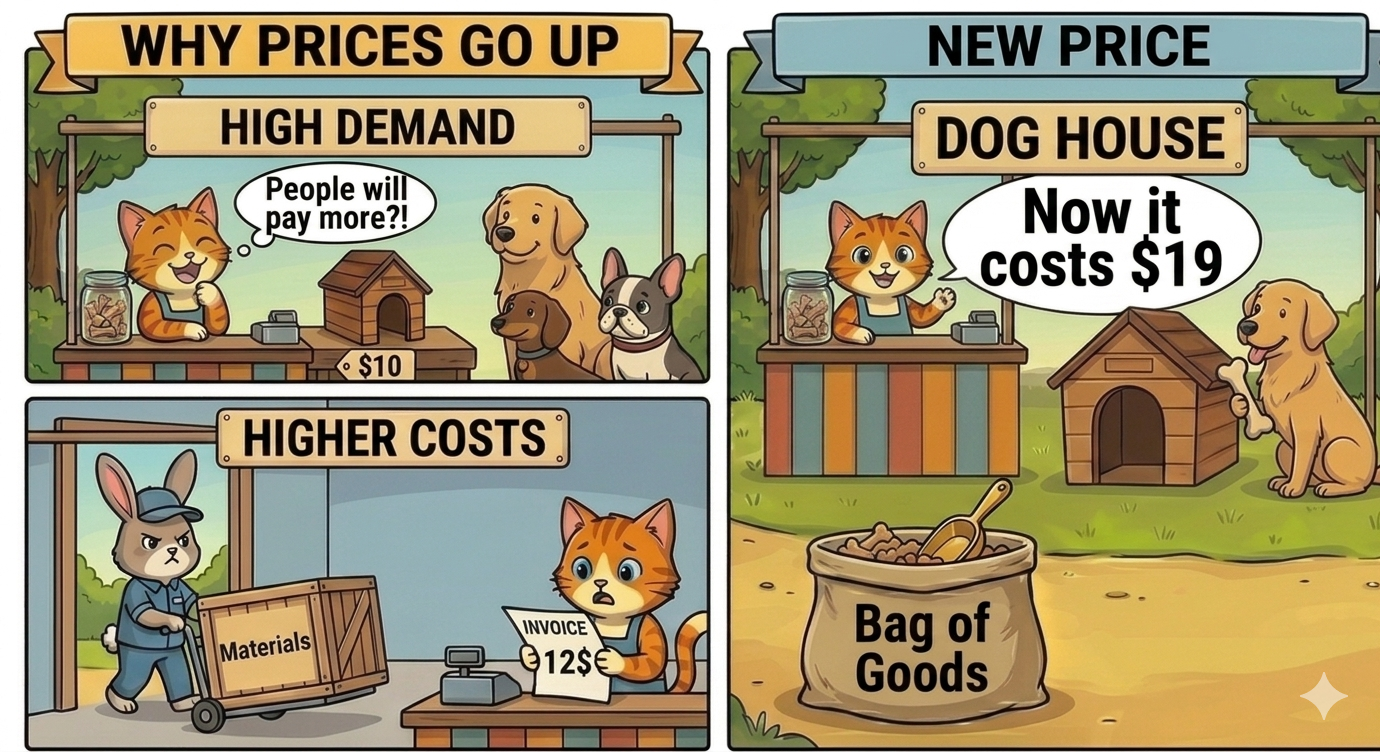
While our comic shows two different "reasons" for prices going up, they are actually two sides of the same coin: the devaluation of the currency. Here is how the pieces fit together.
-
The Common Thread: Money Losing Value
We often say "prices are rising," but it is more accurate to say the value of the dollar is falling. In Demand-Pull (High Demand), the dogs have so much cash that the single dog house becomes more "precious" than the paper bills. In Cost-Push (Higher Costs), the supplier demands more money because the bills they receive don't buy as much fuel or wood as they used to. -
The Engine: Increased Money Circulation
For inflation to be sustained across the whole economy, there must be an increase in the Money Supply. If the total amount of money stayed the same, a price hike in dog houses would eventually force dogs to spend less on treats, keeping the "total bag" price stable.
The reason the entire bag gets more expensive is that there is more money circulating, driven by two main forces:- The Spark (Printing Money): The government/Central Bank increases the "monetary base." This is the initial injection of liquidity into the system.
- The Forest Fire (Bank Lending): This is the primary driver. Through Fractional Reserve Banking, every time a bank takes a deposit and lends it out, they "create" money.
- The Multiplier Effect: When banks lend aggressively to dogs wanting to buy houses or to the bunny’s delivery business, the "Velocity of Money" increases. More "digital dollars" are chasing the same number of goods.
-
The Grand Synthesis (MxV=PxY)
To put it in Mankiw's terms:- M (Money Supply): Increased by government printing and amplified by bank lending.
- V (Velocity): The rate at which the dogs and the shopkeeper trade that money.
- P (Price Level): The cost of our "Bag of Goods."
- Y (Real GDP): The actual number of dog treats and houses produced.
What Matters Most
- Holding cash over long periods erodes your purchasing power—over time, inflation guarantees it will be worth less. In some cases, even durable goods may retain value better than idle cash.
- Investing isn’t just about growing wealth; it’s about preserving—and ideally increasing—your purchasing power over time.
- Don’t be misled by rising numbers alone. A higher balance doesn’t always mean you’re richer in real terms—a million today doesn’t come close to what a million meant 30 years ago. A common rule of thumb is to consider withdrawals of about 4% (Trinity study). (I personally consider 0.2% per month to not reduce the principal)
Sources
- Mankiw, N. G. (2024). Principles of Economics (10th ed.). Cengage Learning.
- Fisher, I. (1911). The Purchasing Power of Money.