All you need to know about investing: a beginner guide
Where to Start
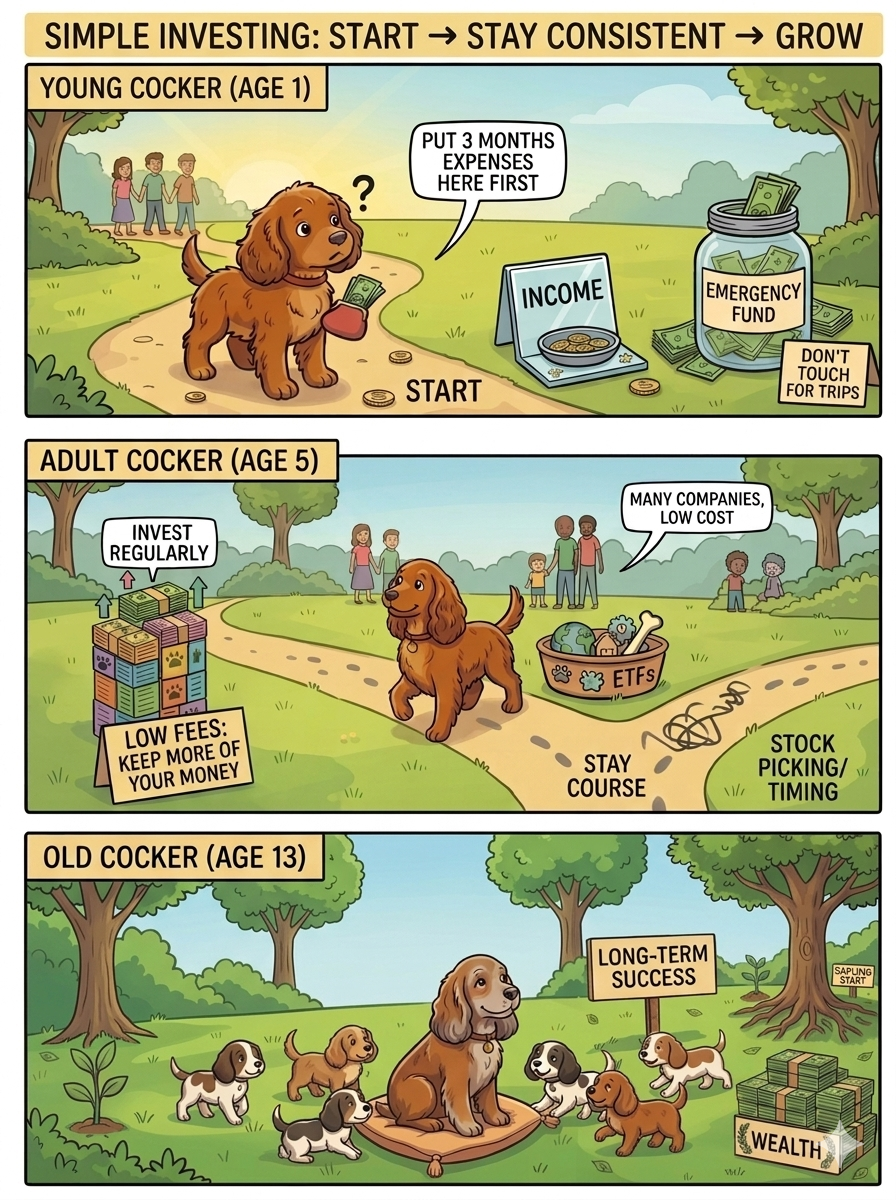
There are many different ways to approach investing. However, for beginners, I strongly recommend following the principles from the Bogleheads investment philosophy for non-US investors .
At its core, this approach is simple, evidence-based, and designed to work over the long term. The key ideas are:
- Develop a clear plan - Define your goals, time horizon, and risk tolerance before investing.
- Start early and invest regularly - Time in the market matters more than timing the market.
- Keep costs low - Fees compound negatively over time and can significantly reduce returns.
- Diversify broadly - Own many assets (typically through index funds) to reduce risk.
- Avoid market timing - Trying to predict short-term movements usually hurts performance.
- Stay disciplined - Stick to your plan, even during market volatility.
- Keep it simple - Complexity often adds risk without improving returns.
The philosophy is built around the idea that you do not need to be clever - you need to be consistent.
Up Your Income
Your biggest financial asset early on is not your portfolio - it is your ability to earn.
Focus on:
- Building valuable skills
- Advancing in your career
- Switching to higher-paying opportunities when possible
- Creating additional income streams
A higher income gives you more capital to invest, which has a far greater impact in the early stages than trying to optimize returns.
Reduce Your Costs
As emphasized in the Bogleheads philosophy, live below your means. This has two major benefits:
- You increase the amount you can invest
- You avoid becoming dependent on an expensive lifestyle
In practice, you often have more control over your spending than your income, especially in the short term. Cutting unnecessary expenses, avoiding lifestyle inflation, and being intentional with money can dramatically accelerate your ability to build wealth.
The Bottom Line
Most investors fail to beat the market over the long run. Even Warren Buffett has repeatedly said that low-cost index funds are the best option for the majority of people.
Even if you can outperform the market, it usually requires significant time and effort. For most people, that energy is better spent elsewhere - on their career, business, or personal development.
This combination - simple investing, higher income, and controlled spending - is what drives long-term financial success far more reliably than trying to outsmart the market.
Simple Investing in Practice
-
Build an emergency fund
Keep a few months of expenses in highly liquid, low-risk assets. This money is not for investing - it is for stability and peace of mind. Choose 1:
- US: High-yield savings accounts, short-term Treasury or short-duration bond ETFs (e.g., SGOV, SHV)
- Brazil: CDBs with daily liquidity (e.g., caixinhas or porquinhos from digital banks), Tesouro Reserva, or similar low-risk instruments
-
Invest in broad, low-cost index funds
Once your emergency fund is set, focus on long-term growth through diversified ETFs with low fees. Choose 1:
- US: Total market and S&P 500 ETFs like VT, VTI, VOO, SPY
- Global (non-US investors): Ireland-domiciled ETFs (e.g., VWRA, IWDA) for tax efficiency
- Brazil: WRLD11 (global exposure), IVVB11 (S&P 500 exposure)
-
Keep expectations realistic
Never build your financial plan assuming high real returns (e.g. 10% real returns). Markets are unpredictable, and overestimating returns is one of the most common investing mistakes. A conservative, long-term mindset is far more sustainable - and far more likely to succeed.